
Welcome to the first of a quarterly column talking to you about our local countryside, what you might see, the highlights of the season, and sharing a few observations and photographs with you.
We start with autumn, a season of change perhaps unlike any other. Shortening days, cooler temperatures and changing colours all tell us that summer is finally behind us. The greens slowly give way to the golds, reds and browns of autumn, while hedgerows become laden with berries and fallen leaves begin to carpet our paths and fields.
From what I’ve seen, it already looks like it could be a very good season for autumn’s bounty. It’s been the best blackberry year I can remember for some time, beech trees are laden with seeds – known as “mast” when they fall to the ground – and the acorns are hanging ripe and fat. Mountain ash, or rowan trees, are also heavy with berries.
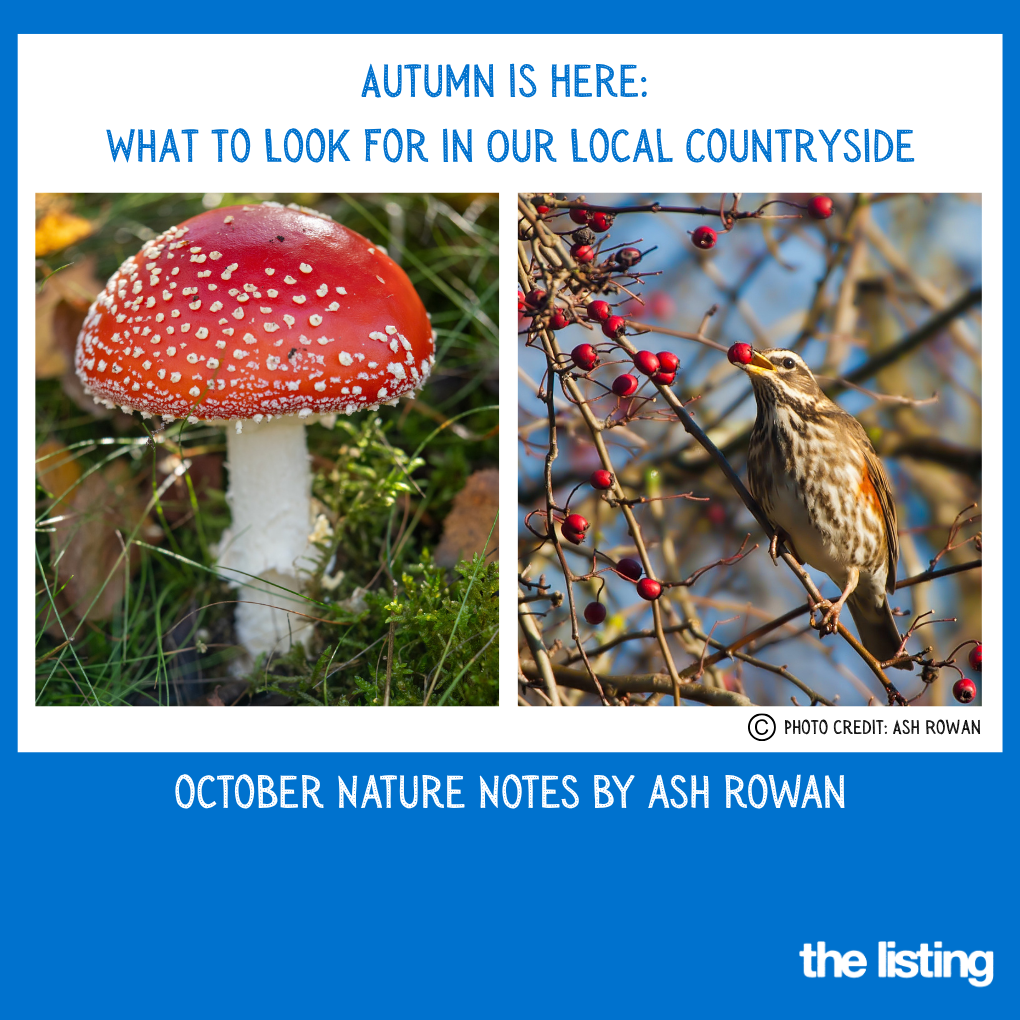
Autumn also brings some welcome visitors from further north. Keep an eye – and ear – out for fieldfares and redwings arriving in our fields and hedgerows.
Both are members of the thrush family, but each has its own distinctive character. The fieldfare is a handsome bird, with a grey head and rump, warm brown back and boldly marked breast. Redwings are smaller, with a creamy stripe above the eye and, if you get close enough, a flash of rusty red beneath the wing that gives them their name.
Listen for the chack-chack of the fieldfare and the high-pitched see-eep, see-eep of the redwing. They can arrive in large flocks, moving from field to field in search of berries and fallen fruit.
Another sign of autumn is the sudden appearance of fungi, sometimes seemingly overnight. Look out for the familiar, almost fairy-tale toadstool, the Fly Agaric, with its bright red or orange-red cap covered in white, wart-like spots. It looks almost as though it has stepped straight out of a children’s storybook. But don’t be tempted to handle it, as it is highly toxic.
One of my favourites to find is the Shaggy Ink Cap, also known as the Lawyer’s Wig. When young, it looks rather like a white, elongated egg standing on the grass. As it matures, the cap opens and the edges begin to turn black and dissolve into an inky liquid. This is a process called “deliquescence”. It can seem as though the mushroom is literally melting away, often leaving just the stem behind. It is a fascinating example of nature’s recycling process, returning nutrients to the soil.
Fox Covert on Therfield Heath and Wimpole Hall Estate are great spots for kicking through the leaves and exploring.
However you spend your autumn, take some time to get out into the countryside and observe what’s happening around you. Enjoy the fresh, invigorating air, and look out for winter’s article in January’s magazine.
And remember: “In order to see, first, you must look.”